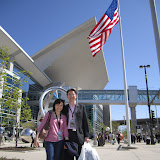
Charlie Munger cordially invites you to attend a Morning with Charlie on Friday, July 1, 2011, at 10:00 a.m., in the Exhibit Hall & Ballroom Building of The Pasadena Convention Center in Pasadena, California. Charlie will make some opening remarks, and then he will take questions from the audience about business, economics and life.The Morning with Charlie will be held regardless of whether the merger between Wesco and Berkshire Hathaway is approved at the special meeting of Wesco’s shareholders, which is currently scheduled for June 24, 2011. Please note that Charlie will not be speaking at the special meeting.The Pasadena Convention Center is located at 300 East Green Street, Pasadena, California. The Convention Center’s parking structure may be accessed from Euclid Avenue, which runs north-south, to the east of the Convention Center. Additional parking can be found nearby, in the shopping center across Green Street to the north, and at the corner of Green Street and Los Robles Avenue, one block to the east of the Convention Center.
Friday, June 17, 2011
“A Morning with Charlie”
Thursday, June 16, 2011
Sugar: The Bitter Truth
Shocking truth about sucrose & fructose.
Robert H. Lustig, MD, UCSF Professor of Pediatrics in the Division of Endocrinology, explores the damage caused by sugary foods. He argues that fructose (too much) and fiber (not enough) appear to be cornerstones of the obesity epidemic through their effects on insulin.
1.5 hours, but worth it. In fact, it is definitely a must-watch presentation.
Luke Johnson: Visionaries need not be mad, but it helps
“There has never been any great genius without a spice of madness,” said the Roman philosopher Seneca. Does this also apply to entrepreneurs?
A new book, called A First-Rate Madness, written by psychiatrist Nassir Ghaemi, postulates that there is a link between mental illness and successful leadership. In particular, the author argues that in times of crisis, the best leaders are the slightly insane ones. For example, he argues that Ted Turner, the inventor of 24-hour television news with CNN, has suffered from bipolar disorder – but that this condition helped him become a billionaire. He inherited his family business at 21 but his creativity and unconventional approach contributed hugely to his achievements.
Many of the finest entrepreneurs I know are extremists – and might be considered a little psychotic. They frequently display traits that are also attributable to the mentally ill. Quite a few are impulsive, domineering, grandiose, fast-talking, distractible and addicted to risk. Another book, published in 2005, called The Hypomanic Edge by John D. Gartner – also a professor of psychiatry – suggests that hypomania endows many Americans with an unusual level of energy, creativity, enthusiasm and wild daring. This mild condition – as opposed to the severe illness suffered by full-blown manic-depressives – is not a necessary prerequisite for those seeking to change the world but it probably facilitates those ambitions.
Is hypomania a gift or a burden? The rebellious temperament and messianic zeal that characterises so many empire builders must be very exhausting. Sufferers – if that is the word – are unlikely to enjoy a tranquil life. Yet harnessing these atypical features can make those possessing them unusually productive. Andrew Carnegie, the Scottish industrial titan, was a classic robber baron: ruthless, impatient, ferociously competitive – but also a dreamer who gave his vast wealth away, saying “he who dies rich dies disgraced”. Carnegie did nothing by half measures and was a bizarre mix of monster and idealist. He had superhuman drive, stating: “The rising man must do something exceptional and beyond the range of his special department. HE MUST ATTRACT ATTENTION.” All his radical behaviours were classic symptoms of a hypomanic.
Tuesday, June 14, 2011
Free Capital: How 12 private investors made millions in the stock market
Excellent written book by Guy Thomas on 12 private investors who become financial independent through investing. This is great encouragement for all private investors.
Free Capital: How 12 private investors made millions in the stock market
All of them have different strategies, but they become successful through swimming their own races and continuously sharpening and improving their skills.

Some great quotes:
The scarcest resource for successful investors is not money but attention: how to manage the trade-off between time and rationality to best effect. There is not time in life to find out everything about every potential investment. Investment skill consists not in knowing everything, but in judicious neglect: making wise choices about what to overlook.
In careers or in investment, it helps enormously to pick the right train – choose a field with long-term secular growth.”
“Most investors would have better performance if they thought more and did less. One of the great tricks in investment is learning to be happy doing nothing.”
“A market doesn’t peak until the majority is convinced it is going to move higher, and it doesn’t bottom until the majority believes it must go lower.”
Portfolio investment is a zero-sum game in which the winners are the players with an informational or analytical edge.
After half a century, he thinks that there are “only two keys to long-term investment success: common sense and patience
“A consensus of expert opinion is not useful in investment, because it’s already discounted by current market prices. That is not true in other fields – medicine or law or even plumbing.
“Reading a biography of Bernard Baruch made a strong impression on me. He was a plunger – that was how he made his fortune. [Gerald M.] Loeb’s The Battle for Investment Survival makes the same point: put all your eggs in one basket, and watch the basket. It made sense to me: to make a large fortune from a small one, you need to be a plunger.”
Free Capital: How 12 private investors made millions in the stock market
Michael Harkin's Speech at Grant's Conference
My last idea also brings me round again to Anatoly Rybakov, who claimed whenever you wanted to hide something from the KGB it was best to leave it face up on the center of your desk. The neighbors would never think to look there. At this odd moment in capitalism, so much value is lying in plain sight, and we think Google is an example. Google makes more money than all the other internet companies Value Line lists in its internet section combined. The internet has been a remarkable destroyer of business models, but not much of a profit generator. Google steps in to that void. Google has $32 billion in cash on hand, which they got the right way. They didn’t borrow it, they have no debt, they didn’t sell something and the cash is the residue, it isn’t lying around from the IPO. This $147 per share is money that they made, and in only 9 years and a bit as a public company. Now I know there’s been some writing in the New York Times that maybe we should give the cash lying around at tech companies some kind of discount, perhaps because it’s not all in dollars and parked in a U.S. bank, or because it hasn’t been all taxed at American rates. But I would like to pose a question to the Timesmen. If you don’t like cash and the rapid accumulation of more if it, what is it you do like about business? This is silly quibbling from the Times, and if you subtract out the $150 in cash per share, and they earn the $31 a share or more I think they will, you just bought yourself a great inflation hedge at effectively 13 times earnings. And look at that record. Buffett and Munger went on and on at last year’s Woodstock about what a moat Google had, and while we’ll note Microsoft’s Bing has made some inroads, it still is hard to compete with these guys. I don’t know what new act in tights Google will come up with next, although last week’s news articles about how Google is looking to nurture old media content providers by stuffing pillows over their heads left me somewhat perplexed. I’m no great seer in this regard, but do you spend your days like me toggling back and forth between the Google page and the Bloomberg machine? This is nothing like insider knowledge, but can you imagine a morning when Larry Page gets out of bed and says, “I wonder if there is anything more in the financial space for us to do?” About two hours later Bloomberg will look like the Quotron machine did twenty years ago. The Bloomberg is some piece of expensive, archaic, annoying architecture, that looks ripe for the taking, and it would move the needle, at least for a year or two, even at mighty Google.
Monday, June 13, 2011
Wednesday, June 08, 2011
Burbank Contrarian Bets
As a hedge-fund manager who thrives on turbulence in the commodities markets, John Burbank couldn’t have done better than the first week of May.
The prices of oil, metals and other raw materials nose- dived the most in two years as investors retreated from emerging markets amid surging inflation in China and India and political upheaval sweeping through the Middle East and North Africa. For Burbank, the founder and chief investment officer of San Francisco-based Passport Capital LLC, the sell-off is an opportunity. He’s looking to add to the heavy bets he’s made in the frontier market of Saudi Arabia, Bloomberg Markets magazine reports in its July issue.
The Saudi monarchy’s decision to roll tanks into neighboring Bahrain to help quell an uprising -- as well as the rebellions in Libya and Syria -- may give some investors pause. Not Burbank, a hedge-fund manager who made his name by earning a 220 percent net return in 2007 after shorting subprime mortgages.
He sees little chance that the Saudi regime will be overthrown or that crude prices will collapse. As the insular kingdom opens up to foreign investors -- it didn’t permit outsiders to buy Saudi stocks until 2008 -- Burbank says now is the time to plow into the country’s petroleum-rich economy.
He’s acquiring stakes in publicly traded petrochemical companies, banks, construction firms and even health-care providers. The Saudi investments made up about 11 percent of Passport’s $2.1 billion flagship fund, Global Strategy, as of May.
Unorthodox Methods
“The crisis isn’t affecting the long-term reality that this is where the oil is,” says Burbank, 47, a beefy man with a full beard who looks more like a longshoreman than an elite money manager. “We want exposure to the Saudi economy because the prices are very cheap and there’s going to be a lot of growth and higher returns on capital, and that’s something that’s likely to play out over a number of years.”
Burbank’s Saudi trade is right in character for a money manager with a knack for using unorthodox methods to exploit the globe’s scarcity of raw materials. While the commodities market’s two-year rally skidded in the second quarter -- crude dropped almost 15 percent and silver shed 28 percent from April 28 to May 9 -- Burbank says the ongoing development of emerging economies will convert little-known raw material producers into money machines for years to come.
Prospecting Skills
Burbank has little interest in trading commodities themselves, which are subject to price distortions as speculators move in and out of markets. Instead, he wants to make a 10-fold return on his investments by purchasing equity in undervalued companies such as oil tanker operators that are poised to grow as long as demand for raw materials steadily rises.
That often involves unearthing small firms that discover mother lodes of highly sought resources, ranging from potash in Kazakhstan to coking coal in Mozambique.
Passport’s investors have profited from Burbank’s prospecting skills. The Global Strategy fund has delivered an annualized 23.6 percent net return since its inception in August 2000, according to data obtained from Passport investors. The HFRX Global Hedge Fund Index gained 4.3 percent in that span, and the Standard & Poor’s 500 Index rose 0.6 percent.
Burbank is racing to beat multinational companies in Australia, China and India that are hunting for new sources of ore, metals and minerals. Passport reaps big dividends when these large players purchase the output of one of the hedge fund’s companies or, even better, the entire enterprise itself.
138 Percent Return
In 2007, Passport started buying shares in Riversdale Mining Ltd. (RIV), an Australian firm developing deposits in Mozambique of coking coal to be used in making steel. Last year, Riversdale was Passport’s No. 1 holding, even though it had yet to mine any coal from the find in Mozambique and lost $799 million.
Burbank’s gamble paid off when Melbourne-based Rio Tinto Ltd. (RIO) made a $3.4 billion bid for Riversdale on Dec. 6 and later increased it to $4 billion. Riversdale shares soared 138 percent in 2010 and helped lift Global Strategy to an 18.2 percent performance after fees. Passport sold most of its shares to Rio Tinto in the first quarter. In early May, Rio Tinto held 73 percent of Riversdale and planned to delist the company.
Burbank, a somewhat rumpled man who shuns neckties and suits in favor of fleece vests and chinos, has long contended our era will be defined by the acute shortage of resources and the decline of debt-strapped economies in the U.S. and Europe.
Underestimated Damage
“I believe the West is bankrupt and failing and it’s just a question of when,” he intoned in his baritone voice to more than 1,700 attendees at the SkyBridge Alternatives Conference for hedge-fund investors in Las Vegas on May 12.
Burbank’s investment record and outspokenness have won him respect from peers who see him emerging as an elite name in hedge funds.
“He’s an original thinker, and he’s got guts,” says Kyle Bass, founder of Hayman Capital Management LP in Dallas, who was at the conference.
Even so, Passport investors have been whipsawed at times during the past decade. In 2008, Burbank almost lost his firm after he underestimated how much damage the global credit crunch would inflict on emerging-market stocks. Confident his long-term bullishness on commodities producers would be rewarded, he added shares of raw materials companies even as investors exited such positions in August and September.
Tuesday, May 24, 2011
Sunday, May 15, 2011
Thursday, April 14, 2011
Subscribe to:
Posts (Atom)